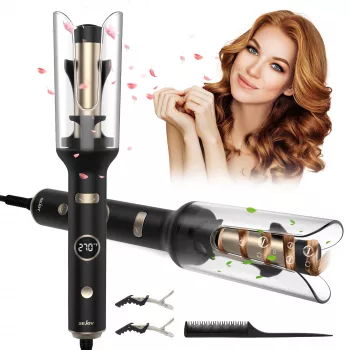
Creating consistent curls at home gets easier when the barrel rotates for you and the heat can be set precisely. An automatic rotating-barrel curler helps wrap each section evenly while ceramic heat and digital temperature settings support smoother results across different hair types. Below is a practical guide to how this kind of tool works, what to look for, and how to use it safely for soft waves or more defined spirals. For more guidance, see 8 Best Curling Irons, Tested by Our Experts – Consumer Reports.
A rotating-barrel curler is designed to do the “wrapping” step for you. Instead of manually twisting your wrist and feeding hair around the barrel, the tool’s rotation helps guide the strand into a more uniform wrap—often the difference between a polished curl pattern and a mix of bends and flat spots. For further reading, see Chi Rotating Curling Iron.
| Feature | Manual curling iron | Automatic rotating-barrel curler |
|---|---|---|
| Wrapping method | Hand-wrap hair around barrel | Barrel rotates to wrap hair |
| Curl consistency | Varies with technique and tension | More consistent from section to section |
| Learning curve | Moderate to high | Beginner-friendly |
| Risk of uneven bends | Higher if hair overlaps | Lower with controlled wrap |
| Temperature control | Depends on model; sometimes dial-based | Digital settings for precision |
Not all rotating curlers behave the same, especially across fine, color-treated, thick, or naturally textured hair. The best pick is the one that lets you control heat and workflow so you don’t have to “fight” your hair with extra passes.
Automatic rotation can make curling faster, but the best results still come from prep, sectioning, and a cool-down phase. If curls drop quickly, it’s usually a section size or temperature mismatch—not a sign you need to clamp longer and risk damage.
| Hair type/condition | Suggested starting range | Tip for better hold |
|---|---|---|
| Fine or damaged | 250–300°F (120–150°C) | Use smaller sections; cool curls fully |
| Normal/medium | 300–350°F (150–175°C) | Alternate curl direction for volume |
| Thick/coarse | 350–410°F (175–210°C) | Work in clean sections; avoid multiple passes |
For additional hair-damage prevention basics, see guidance from the American Academy of Dermatology Association and an overview of common breakage triggers from the Cleveland Clinic.
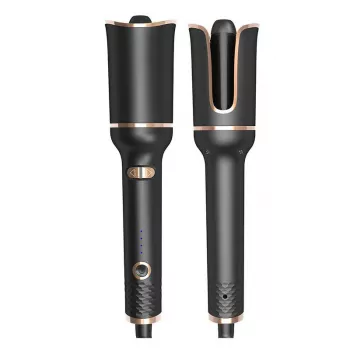
Automatic Ceramic Hair Curler with Rotating Barrel & Digital Temperature Control is available now for $24.82 (in stock).
| Detail | Value |
|---|---|
| Product | Automatic Ceramic Hair Curler with Rotating Barrel & Digital Temperature Control |
| Price | 24.82 USD |
| Availability | In stock |
| Best for | Beginner-friendly curls and fast touch-ups |
Yes, with smaller sections and careful positioning. Aim for mid-shaft wraps rather than trying to curl from the very root, and keep the barrel slightly away from the scalp for safety.
Start low and increase only if needed. Many people do well around 250–300°F (120–150°C) with heat protectant and a short hold time.
Use smaller sections, let curls cool completely before brushing, and finish with a light hold product. If hair is very clean and slippery, a little texture spray can help with grip.


Leave a comment